
Bench Warrants in Marion County
A bench warrant in Marion County is a judge's order tied to a court obligation. Indiana pretrial rules define failure to appear as a nonappearance after which a court may issue a warrant. The missed date can land in a criminal, traffic, family, or other division. The same phrase does not trigger the same process everywhere. Valid notice matters. So does a granted continuance. Later court action can also change how the docket reads. Marion County courts use the terms bench warrant, arrest warrant, warrant for failure to appear, summons, and civil writ of attachment. Capias is not a standard Indiana term here. Start with the words the issuing court itself uses.
Failure to Appear Is an Event
Failure to appear, often marked FTA, is an event on the Marion County docket, not a finding. Read the entries in order. A docket may show the hearing date, the nonappearance, the warrant order, a later surrender, bond review, a recall, or a reset. One line cannot prove notice was proper. Nor can it show whether the judge later changed the order.
- FTA
- A missed required appearance after which a court may issue a warrant.
- Recall
- The court withdraws the warrant.
- Quash
- The court sets aside the warrant or process.
- Return
- A service or outcome entry after process was issued.
- Surrender
- A voluntary appearance that leads to further court action.
The Indiana pretrial definitions page shows how failure to appear is used in the state court framework that governs Marion County.
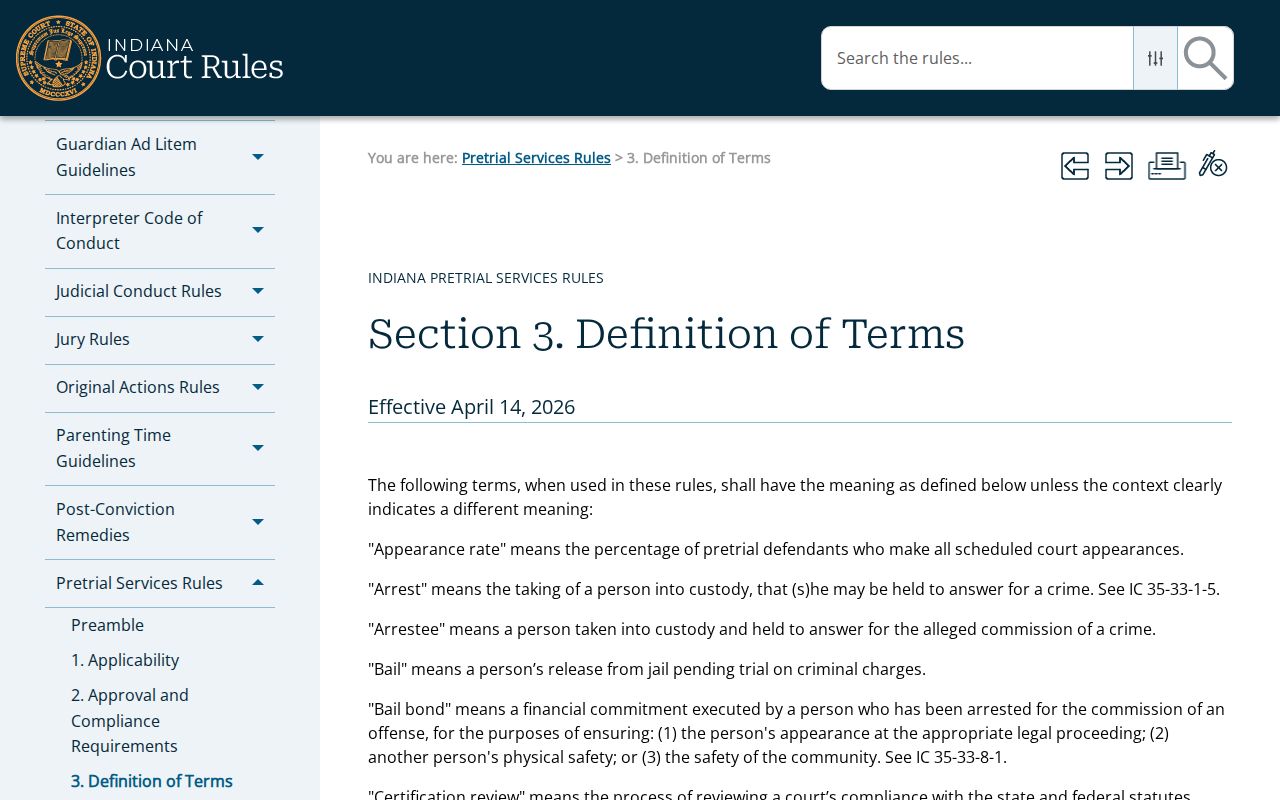
The rule supplies the trigger definition. The Marion County issuing court's docket shows whether a recall, surrender, or later hearing changed the warrant. Recall is not expungement. A recall ends the warrant, while expungement concerns legal access to eligible records.
How a Bench Warrant Is Issued
The judge acts within the case after a missed appearance, a failure to comply, or another court-directed event. The clerk records the order and every related docket event. The sheriff receives court process for service. Authorized city police in Marion County may execute local process. Across Marion Circuit Court, Superior Court, Municipal Court, and other clerk-served divisions, the Marion County Clerk keeps the court warrant record. Use Indiana MyCase to locate an eligible public case. Search the cause number when known. A name search can be narrowed by first and middle name, date of birth, court, status, and filing dates. Open and Closed are case filters, not bench-warrant status fields, so the court or Clerk must confirm the latest order.
Marion Family Warrant Safeguards
Marion County's family rules get unusually specific. They lay out a bench-warrant process that calls for personal service on the adverse party plus a completed bench-warrant information sheet. After copy service, the court may act once sworn testimony establishes actual notice. That safeguard is why a family bench warrant should not be read like a criminal or traffic failure-to-appear warrant. The Marion local rules are the official source. The family division supplies the bench-warrant information sheet. Ask that division what notice and filing appear in the current case. Notice can shape the process. Still, a public reader should not decide validity alone. Counsel and the issuing judge are the proper route for a disputed service issue.
Bench Warrant vs Arrest Warrant
Both orders can put a person in custody, but the paths differ. A Marion County bench warrant usually answers conduct inside an existing case, such as a missed date. An arrest warrant follows Indiana's statutory charging and probable-cause framework. A summons commands an appearance without immediate arrest authority. The public docket and the issuing order show which path applies.
| Process | Typical starting point | Key record |
|---|---|---|
| Bench warrant | Missed appearance or unmet court order | Existing case docket and judge’s order |
| Arrest warrant | Indictment or information with the required probable-cause path | Written warrant and criminal case record |
| Summons | Direction to appear in an eligible matter | Summons and response history |
| Civil attachment | Separate civil enforcement procedure | Proposed writ, return, recall, or expiration record |
A civil writ of attachment in Marion County is not proof of criminal conduct. Marion local rules give it separate bail, return, and expiration provisions.
Missed Marion County Court Date
Miss a Marion County court date and the cause number is your first tool. Pull it up, find your division, and read every docket entry after the setting you missed. The record tells the real story. A continuance may have been granted, a warrant may have issued, or the court may have reset or recalled it. No reminder text or third-party calendar replaces the docket itself.
- Search MyCase and save the cause number, division, missed date, and latest docket event.
- Use the Marion Courts listings to find the correct criminal, traffic, family, ordinance, or Initial Hearing route.
- Ask the issuing division or Marion County Clerk whether a warrant was issued and remains current.
- Ask counsel whether the case requires a motion, reset, appearance, bond step, or planned surrender.
- Follow the court’s exact direction rather than arriving at an unrelated office.
The Marion County Sheriff's general line can route a service question, but the office publishes no warrant-specific phone confirmation procedure.
How to Resolve a Marion County Bench Warrant
No single step clears every Marion County bench warrant. The issuing court may require a motion to recall or quash, a new hearing, payment in a qualifying case, counsel, surrender, arrest processing, or an Initial Hearing. Current bond terms also matter. A general bail schedule cannot replace the warrant order.
Act through the court. Confirm the order and consult counsel before appearing. Paying a balance, calling the sheriff, or visiting any courthouse does not automatically clear a bench warrant.
Marion County's bail schedule treats an active warrant, an open case, parole, or probation as reasons to hold a person until Initial Hearing Court or the trial court weighs in. A pre-set warrant bond is not the same thing as an outright arrest. Get the real amount from the current order or the court itself. A generic estimate helps no one. For some eligible non-felony matters, Safe Surrender has taken calls at 317-327-SAFE. Confirm the program's current scope before you count on it.
Marion County Bench Warrant Records
A Marion County public case record is really a chain of linked fields and events. No badge in it simply says active. Track the cause number, the issuing division, and the event date, since no standard public warrant-number format exists.
| Cause number | The case identifier used by MyCase and the court. |
|---|---|
| Issuing division | The court that entered and can change the order. |
| Triggering event | Failure to appear or another stated compliance event. |
| Order date | The bench-warrant entry date. |
| Later action | Return, surrender, recall, quash, bond review, or hearing. |
| Case status | Open or Closed category, not a live warrant answer. |
Read a Marion County docket's later entries before drawing any conclusion, because MyCase itself warns that its online data is not the official record.
Which Marion County Court Issued It
Finding the right door starts with the Marion court map, which sorts Circuit Court from Superior Court's criminal, civil, family, traffic, ordinance, and Initial Hearing work. The court contact PDF lists C01 plus D01 through D36. A cause number usually points you toward the correct division. Marion County Municipal Court handles misdemeanors, infractions, ordinance violations, and concurrent Level 6 felony jurisdiction. Beech Grove City Court is another lower-court path, and its official site claims countywide jurisdiction over Beech Grove, Lawrence, Southport, Speedway, Clermont, Homecroft, Williams Creek, school-police, and State matters. Published listings disagree about its address, so confirm the current location before visiting. Township Small Claims Courts stay civil and hold no general criminal bench warrants. One elected Clerk serves all of these courts. There is no separate county warrant clerk. Ask for the division named on the docket rather than calling a random agency in Marion County.
Different Marion Warrants Need Different Calls
Not every Marion County warrant works the same way. A family bench warrant may hinge on personal service and notice. A traffic failure-to-appear warrant can involve BMV notice under Indiana law. A criminal bench warrant can mean arrest and an Initial Hearing. A civil attachment follows the local civil rule, can expire after 120 days, and stays subject to recall under that rule's terms. Each record may use the word warrant while running through a separate channel. Beech Grove's payment routes and Speedway's ordinance process are not a universal warrant-clearance system. The court holding the matter must say whether payment, a reset, or another filing affects the warrant. An Indianapolis parking citation takes a different administrative route entirely and is not a criminal bench warrant. So the real Marion County question is not whether the word warrant appears. It is which court entered the order, what happened after entry, and what that court requires now.